
Numerous investors evaluate retirement income with the inquiry: “What yield can I achieve?”
It appears sensible to pursue the highest dividend stream for income, yet this question frequently misguides investors. A substantial yield may seem attractive, but it does not guarantee safety, growth, or sustainable retirement income. In fact, the reverse is often the case.
Investors who concentrate excessively on yield may find themselves with slower-growth enterprises and susceptible firms. Consequently, the most effective dividend investors ultimately become yield agnostic, prioritizing quality over the size of the yield.
Yield is merely a superficial metric. A stock yielding 5% is not inherently superior to one yielding 2%. The crucial aspect is whether the business can maintain that payout and continue to grow.
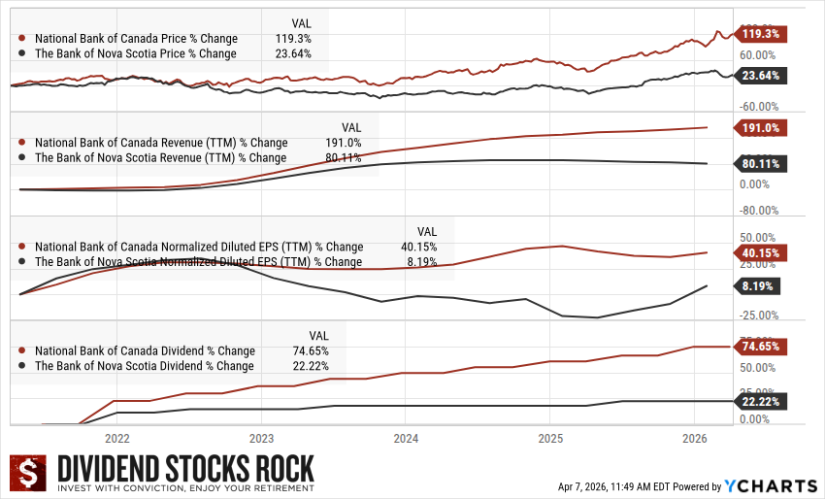
My approach has shifted to be yield agnostic, concentrating on a solid investment thesis and favorable trends within the Dividend Triangle: revenue, earnings, and dividends. By selecting quality, one can prevent dismissing excellent companies with lower yields and protect against high yields concealing weak growth or increasing risk.
Sustainable income arises from the strength of the business. Retirees often aspire to “live off the dividends” without depleting the capital. However, income is tied to the portfolio’s overall return, not merely the current yield. Without substantial returns, income strategies can become shaky.
High yield from weaker companies can quickly turn disappointing. Conversely, companies with robust dividend growth provide better chances of consistent income. In challenging markets, dividends are not impervious to business pressures, and firms can reduce payouts.
An illustration is the comparison between National Bank (NA.TO) and Scotiabank (BNS.TO). Evaluating by yield alone may favor Scotiabank. However, National Bank displays superior performance and business momentum within the Dividend Triangle.
National Bank has broadened its scope beyond conventional banking and grown through acquisitions and various growth strategies. While it carries some risk, it has rewarded investors with stronger growth.
Scotiabank’s global presence provides potential for growth but comes with volatility and risk. It has struggled to convert this into outstanding returns. Yield-focused investors may overlook these growth distinctions.
Yield-agnostic investors expand their horizons, not confining themselves to high-yield stocks. They emphasize company growth and management effectiveness, concentrating on sources of income rather than current payout levels. Strong portfolios are constructed on resilient firms with increasing earnings and adaptable market strategies.
The essence of successful dividend investing is not pursuing the highest payouts; it is investing in the strongest businesses. Quality should take precedence over yield. By focusing on quality elements like the Dividend Triangle, you can avoid cuts and secure lasting retirement income.
A significant yield may appear reassuring, but a strong business guarantees sustainable income. For more insight on creating a retirement strategy focused on dividend growth, refer to the Dividend Income for Life guide.
This is where the genuine conversation about retirement income commences.